Introducing Context Blog: built for AI visibility
An agent-run content engine that plans, checks, publishes and improves every post for search and AI discovery, with human approval before anything goes live.
Context Blog is an agent-run content engine for search and AI visibility. It plans around audience questions, drafts with source and structure guardrails, requires human approval, publishes the technical SEO layer, then measures whether search engines and AI assistants discover and cite your work.
Publishing more words is not the hard part. The hard part is making work useful, defensible and easy for search engines and AI assistants to understand — then learning whether they found it. Context Blog puts that loop around the assistant you already use.
Search has a second results page now
A reader may still click a blue link. They may also ask ChatGPT, Claude, Gemini or Perplexity and receive an answer assembled from cited sources. Context Blog treats traditional search and those generated answers as one discovery problem: write clear source material, publish the technical signals, measure what appears and use the evidence to choose the next edit.
The product is the loop around the writing
Context Blog starts with your audience, voice, claims policy and the questions you want to own. It turns that brief into a plan in Context, drafts against it, checks the work in a separate pass, waits for your approval, publishes the discovery layer and brings performance evidence back into the next topic.
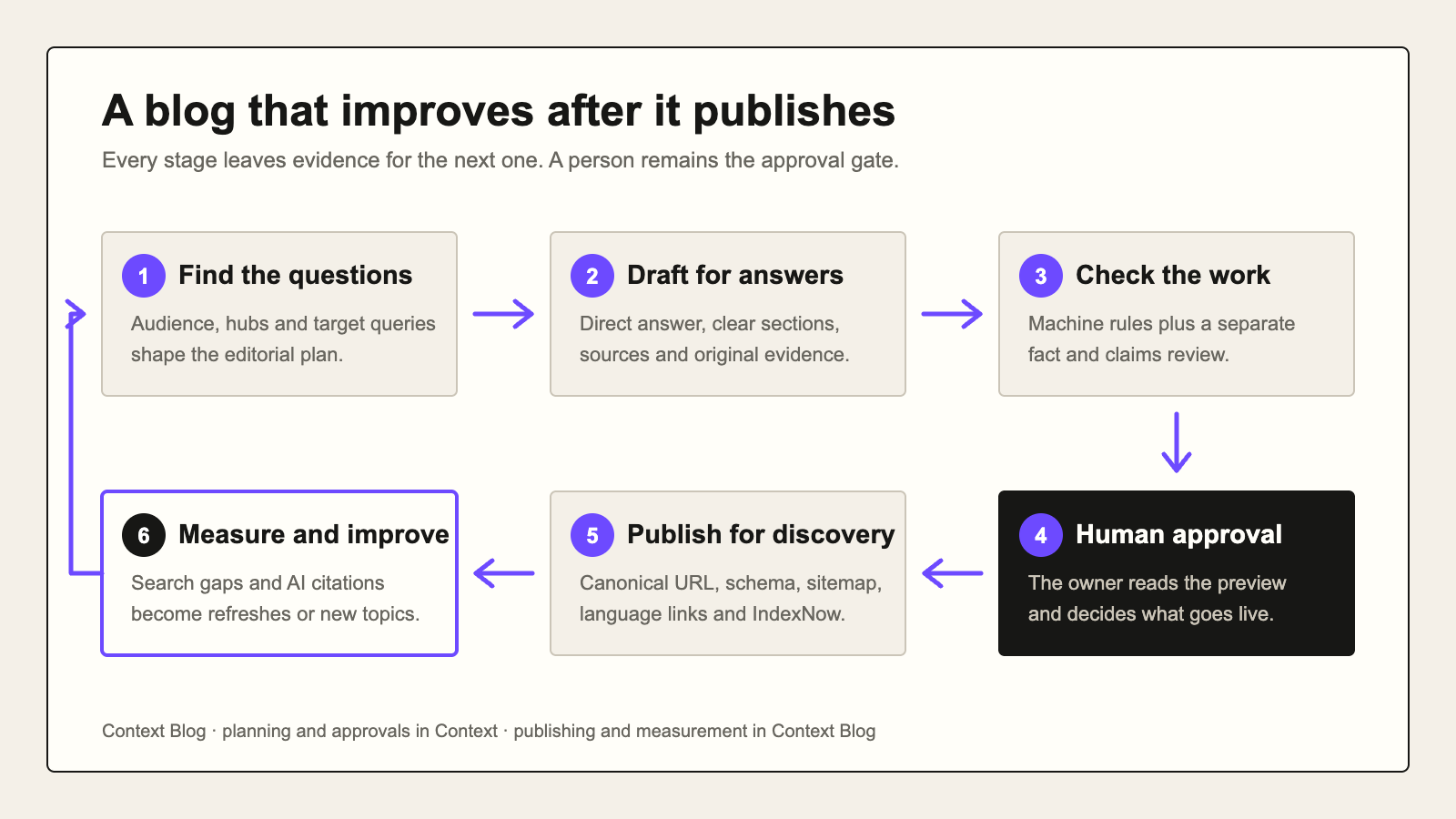
- Find the questions. Research becomes hubs, target queries and a backlog.
- Draft for answers. Lead with a direct answer, sources and original evidence.
- Check the work. Machine rules run first; a separate checker reviews facts, links, voice and claims.
- Ask a person. You receive the draft, verdict and preview in Context. Nothing goes live until you approve it.
- Publish for discovery. Hosted blogs ship the page and search infrastructure together.
- Measure and improve. Search gaps and AI citations become refreshes or new topics.
Optimization happens before the publish button
Each draft is shaped for a real question before it reaches you. The opening answer is short enough to stand alone. Every main section starts with a complete thought a citing system can lift without losing its meaning. Sources, factual numbers and original evidence are required, while banned phrases and claims you refused are checked automatically.
- Question-led planning: every post belongs to an audience hub and a stated query.
- Answer-first structure: the useful answer appears before the throat-clearing.
- Evidence: links and factual numbers are checked; original artifacts must be backed by the brief.
- Independent review: the checker can bounce the draft or escalate an unsettled claim.
- Bounded guardrails: repeated disagreement goes to you instead of looping forever.
Publishing includes the discovery layer
On the Hosted tier, approving a post publishes more than the visible article. Context Blog also keeps its canonical URL, language links, sitemap, RSS feed, social card and machine-readable article data current. Google describes structured data as explicit clues about a page, while its sitemap guidance is careful to call submission a hint rather than a guarantee.
- Structured data: Article, Organization, BreadcrumbList and FAQPage markup describe the page and its publisher. Google's documentation explains how structured data helps its systems understand a page.
- Canonical and language links: one preferred URL per page, with localized versions cross-linked rather than competing silently.
- Sitemap and RSS: current URLs are generated automatically. Google notes that a sitemap helps discovery but does not guarantee indexing.
- IndexNow: when a hosted tenant has its own hostname and indexing is enabled, publish notifies participating engines about the changed URL. The protocol and its verification rules are documented by IndexNow.
AI visibility becomes something you can inspect
Traffic tells only part of the story. Context Blog can separate assistant referrals and maintain a list of the questions that matter to your brand. A weekly agent-side probe asks those questions across selected engines, records whether your site was cited, mentioned or absent, and keeps the cited URL, rank and previous result for comparison.
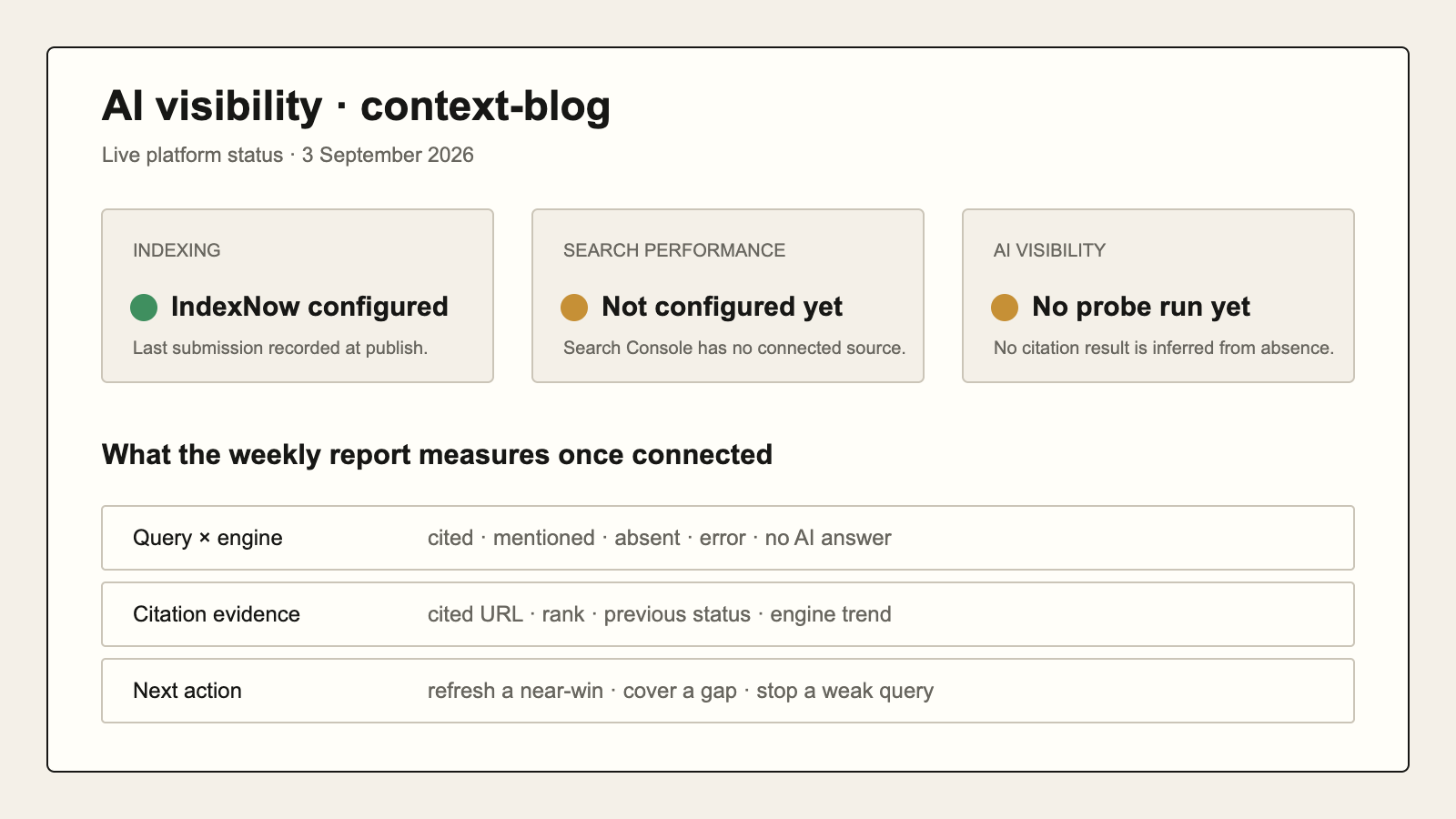
The report is designed to lead to an action. A search query sitting close to the first results becomes a refresh candidate. A question where other domains are cited and yours is absent becomes a content gap. A query that stays weak without a relevant page can be dropped. Referral data is treated as an undercount, and a missing probe is never reported as zero visibility.
What is real at launch
The platform already serves the Meetly catalogue on its own domain: 100 imported posts across 7 languages at launch. That proves the publishing layer, not the new writing loop, and we keep that distinction explicit. Missing traffic or visibility data is named as unconfigured rather than turned into a made-up chart.
This article is closer proof: its first published version ran through the checker 3 times before it passed.
Start with one interview
Context Blog works through MCP, the open protocol that lets an assistant use external tools. Connect one Context — the iPhone app or the web app — plus Context Blog. The setup interview captures your voice, audience, topics, claims and publishing rhythm. The guide shows the complete workflow and the differences between Artifact, Review and Hosted tiers.
See the setup, approval and publishing loop from the first connection to the weekly visibility report.
Read the guideFAQ
What do AEO and GEO mean in Context Blog?
Answer engine optimization and generative engine optimization mean preparing useful source material for systems that answer questions, not only for a list of search results. Context Blog turns audience questions into target queries, requires direct answer passages, checks citations and original evidence, publishes structured technical signals, then measures whether selected assistants cited, mentioned or ignored the site. The terms describe the whole feedback loop today. They do not mean adding hidden text, repeating keywords or trying to manipulate a model.
Does Context Blog guarantee search rankings or AI citations?
No. A sitemap is a discovery hint, structured data helps machines understand a page, and IndexNow can notify participating engines that a URL changed. None of those controls what an engine indexes, ranks or cites. Context Blog guarantees only the parts it owns: the page follows the selected guardrails, its evidence is checked, the technical publishing layer is generated, and configured measurements are reported without filling gaps with estimates. The result is a better-controlled publishing process, not a promised position.
What does the AI-visibility report measure?
For each target question and selected engine, the report stores one of five explicit states: cited, mentioned, absent, error or no AI answer. A citation carries the URL, its position when available and the result from the previous period. The report also groups results by engine and shows which other domains received citations. Known assistant referrals are reported separately from the probe. Because referral headers and model search APIs are incomplete views, Context Blog presents trends and source coverage rather than pretending they are a complete census.
Can anything publish without my approval?
The workflow says no. The maker drafts, an independent checker records a pass, bounce or escalation, and the issue in Context presents the draft, verdict and rendered preview to you. The publishing routine is allowed to act only after it reads that issue as approved. For a refresh such as this article, the revised body is staged through lint and preview before it replaces the published row, so the public page does not change while the decision is still yours. The approval trail remains attached to the issue.